
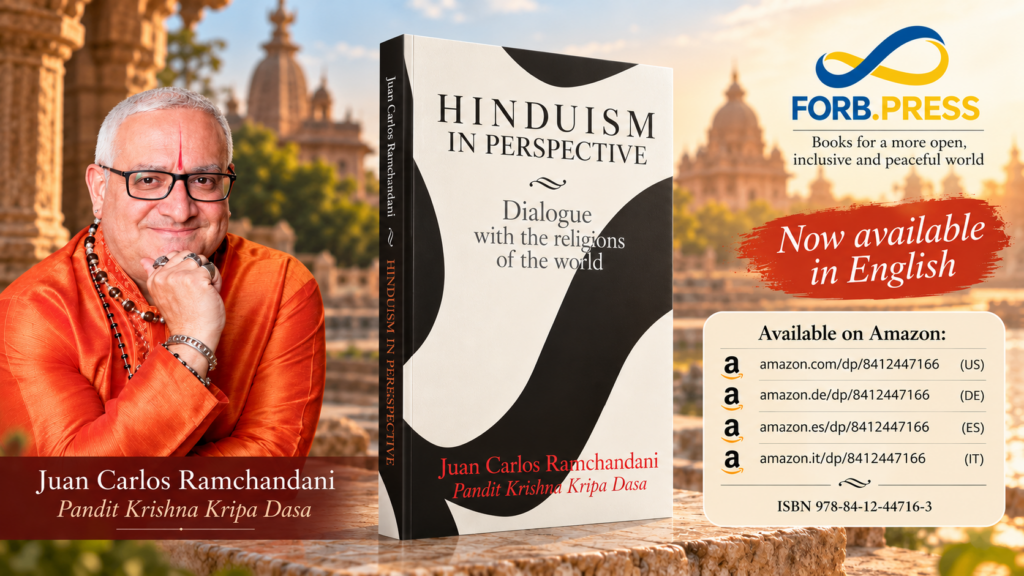
Juan Carlos Ramchandani’s new English edition explores similarities and differences between Hinduism and thirteen religious traditions, placing encounter and interreligious dialogue at the centre of the conversation.
FoRB Press has launched the English edition of Hinduism in Perspective: Dialogue with the Religions of the World, by Juan Carlos Ramchandani, also known by his Hindu name Pandit Krishna Kripa Dasa.
Published in October 2026, the book approaches religious diversity from within the Hindu tradition, bringing Hinduism into dialogue with thirteen other religious and philosophical traditions while examining both the beliefs they may share and the differences that distinguish them.
The English edition, ISBN 978-84-12-44716-3, follows the original Spanish publication, Hinduismo en Perspectiva: Diálogo con las religiones del mundo, and makes Ramchandani’s comparative exploration available to a wider international readership.
The courage to encounter another belief
For FoRB Press, the decision to publish the English edition is closely connected to a principle at the heart of freedom of religion or belief: people should be able not only to hold different convictions, but also to encounter those who believe differently with dignity and curiosity.
That idea is developed in the Editor’s Foreword, titled The Courage to Encounter, written by FoRB Press Director Iván Arjona-Pelado.
“Genuine dialogue requires courage,” the foreword states: courage to step outside what is familiar, to listen to people as they understand themselves and, at times, to discover that assumptions inherited about another religion were incomplete or mistaken.
It is an idea summarized in another line from the foreword: “Prejudice thrives at a distance.” Encounter, by contrast, creates the possibility of understanding.
This does not mean pretending that religions are identical. One of the distinguishing features of Hinduism in Perspective is precisely its willingness to address theological and philosophical differences rather than reducing different traditions to a comfortable common denominator.
“Knowledge helps overcome fear. Dialogue challenges prejudice,” Arjona-Pelado writes. The objective is not simply to learn facts about another religious tradition, but to develop the courage to encounter the people behind religious labels.
Hinduism looking outward
Ramchandani begins the book by introducing the foundations of Hinduism, or Sanatana Dharma, including its sacred literature, its understanding of the Divine, concepts such as dharma, karma, samsara and moksha, its different spiritual paths, religious practice and the role of the guru.
He then turns outward.
The book places Hinduism alongside religions of Indian origin — Buddhism, Jainism and Sikhism — before moving to Confucianism, Taoism and Shinto. It subsequently examines Hinduism in relation to Judaism, Catholic Christianity, Protestant Christianity and Islam, before concluding its comparative chapters with the Bahá’í Faith, the Unification Church and Scientology.
Each encounter considers areas of convergence while also identifying significant differences involving such questions as the nature of God or ultimate reality, the soul, reincarnation and resurrection, revelation, salvation or liberation, sacred images, religious authority, spiritual practice and the place of religious community.
Ramchandani is explicit about the perspective from which he writes. He describes the book not as an academic study in the strict sense, but as an open and respectful reflection arising from his own experience of interreligious dialogue.
Unity without uniformity
A recurring reference throughout the book is the Vedic expression Ekam sat viprah bahudha vadanti — commonly rendered as “Truth is one; the sages call it by different names.”
For Ramchandani, that idea offers a distinctively Hindu point of departure for religious dialogue: diversity does not necessarily have to be perceived as a threat.
At the same time, the author does not argue that all religions say the same thing.
Buddhist understandings of the self differ substantially from Hindu concepts of Atman. Jain teachings about liberation and the cosmos are not Hindu theology. Sikhism has its own distinctive understanding of God and religious authority. Judaism and Islam differ sharply from Hindu practice in their approaches to divine images, while Christianity introduces fundamentally different concepts of incarnation, salvation, resurrection and history.
The dialogue becomes meaningful precisely because those differences remain visible.
That approach reflects one of the principles FoRB Press seeks to encourage through its publications: mutual respect does not require theological agreement, and serious interreligious dialogue should neither conceal difference nor turn difference into hostility.
From comparative religion to coexistence
The final part of Hinduism in Perspective moves beyond comparison to ask what religions can contribute to coexistence.
Ramchandani highlights personal encounter, interreligious education, social cooperation, nonviolence, care for nature, shared service and respect for the dignity of different traditions. He also argues for what might be one of the more demanding aspects of dialogue: historical humility.
Religious communities, he suggests, should be capable of acknowledging episodes of intolerance and conflict within their own histories while continuing to draw upon their traditions as resources for reconciliation.
This makes the book relevant beyond readers specifically interested in Hindu theology. It addresses a broader question facing increasingly plural societies: how can people hold deep religious convictions while living constructively alongside people whose convictions may be entirely different?
An author shaped by more than one religious world
Juan Carlos Ramchandani was born in Ceuta in 1970 to an Indian Hindu father and a Spanish Catholic mother, a background that placed encounters between religious traditions within his own life from an early age.
He formally entered the Hindu tradition in his youth and was later initiated into the Gaudiya Vaishnava and Sri Vaishnava traditions. He was ordained as a Hindu priest, or purohita, in 1994 and received the title of pandit in 2000.
Over several decades he has travelled extensively throughout India, studied Hindu philosophy and ritual, written and lectured on Hinduism and participated in interreligious initiatives in Spain and internationally.
In 2015, he became the first president of the Hindu Federation of Spain. He has also served as vice president of the Hindu Forum of Europe and participated in European and international initiatives dealing with religious diversity, dialogue and conflict mediation.
That personal history helps explain why Hinduism in Perspective is concerned not only with what religious traditions teach on paper, but with what happens when their adherents actually meet.
A book about difference — and what we do with it
Religious freedom is sometimes described mainly in legal terms: the freedom to believe, not to believe, change belief, worship, teach and manifest religion individually or together with others.
Those protections are indispensable. But law alone cannot create a culture of religious freedom.
Such a culture also depends upon what happens when neighbours, colleagues, students, religious leaders and communities encounter beliefs they do not share or fully understand.
This is where the central proposition of Hinduism in Perspective becomes particularly relevant. Dialogue does not ask people to abandon identity. Nor does it require differences to disappear. It asks whether disagreement can coexist with curiosity, dignity and respect.
As the Editor’s Foreword puts it, behind every religious label are human beings seeking meaning, truth, belonging and transcendence.
With the publication of this English edition, FoRB Press hopes Hinduism in Perspective: Dialogue with the Religions of the World will contribute to that encounter — not by offering the last word about the religions it discusses, but by encouraging the next conversation.
Hinduism in Perspective: Dialogue with the Religions of the World
Juan Carlos Ramchandani — Pandit Krishna Kripa Dasa
FoRB Press
English edition: October 2026
ISBN: 978-84-12-44716-3
The English edition is available through Amazon:
https://www.amazon.es/dp/8412447166
More information about FoRB Press:
https://www.forb.press/